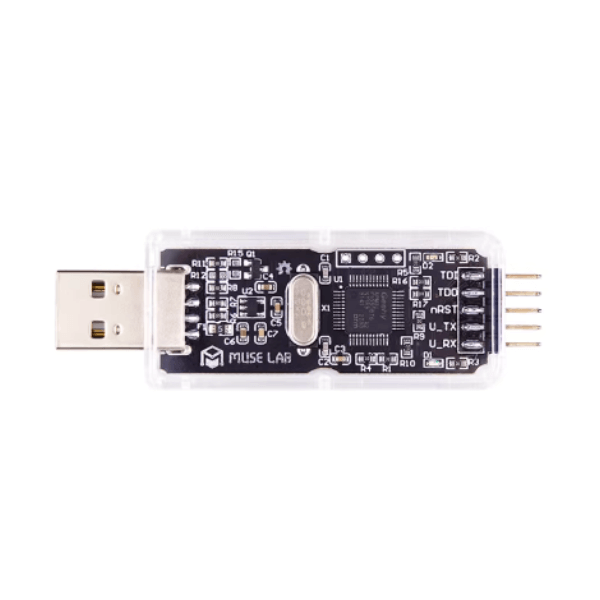
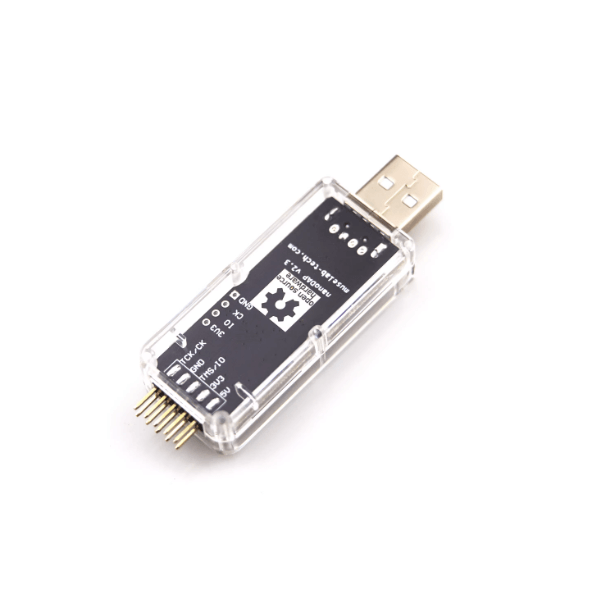
Product Overview
The DAPLink Simulator is an open source hardware and software debugger developed by Muse Lab. Compared to popular commercial tools like J Link or ST Link, it offers faster programming speed, no firmware loss, no copyright restrictions, rich functionality, a compact design, and a lower cost-making it ideal for the daily development, debugging, and programming needs of electronics engineers and embedded developers.
- Product Name: DAPLink Simulator
- Supported Debug Interfaces: JTAG, SWD, virtual COM port
- Supported IDEs: Keil/MDK, IAR, OpenOCD
- Target Chips: All Cortex M based MCUs (e.g., STM32, NRF51/52) and, via OpenOCD, other architectures (Cortex A, DSP, FPGA, MIPS, etc.)
- Supported OS: Windows, Linux, macOS
- Input Voltage: 5V (USB powered)
- Output Voltage: 5V / 3.3V (can power the target board directly)
- Dimensions: 71.5mm×23.6mm×14.2mm
Key Features
- Fully Open Source – Both hardware and software are open source, eliminating copyright risks and firmware lockouts often associated with pirated J-Link/ST-Link clones.
- Dual Interface Support –
- – JTAG: Works with OpenOCD to debug a wide range of SoCs including ARM CortexA, DSP, FPGA, and MIPS.
- – SWD: Fully compatible with mainstream IDEs (Keil, IAR, OpenOCD) for step by step debugging and programming of Cortex M cores.
- Built in Virtual Serial Port – Can also function as a USB to serial adapter, replacing chips like CH340, CP2102, or PL2303.
- Broad Chip Compatibility – Supports all CortexM based microcontrollers, along with extended support for other architectures via OpenOCD.